Europe’s New High-Speed Horizon: The EU’s Push Toward a Unified Rail Future
Source: European Commission – Mobility and Transport; Global Railway Review
11/6/20252 min read
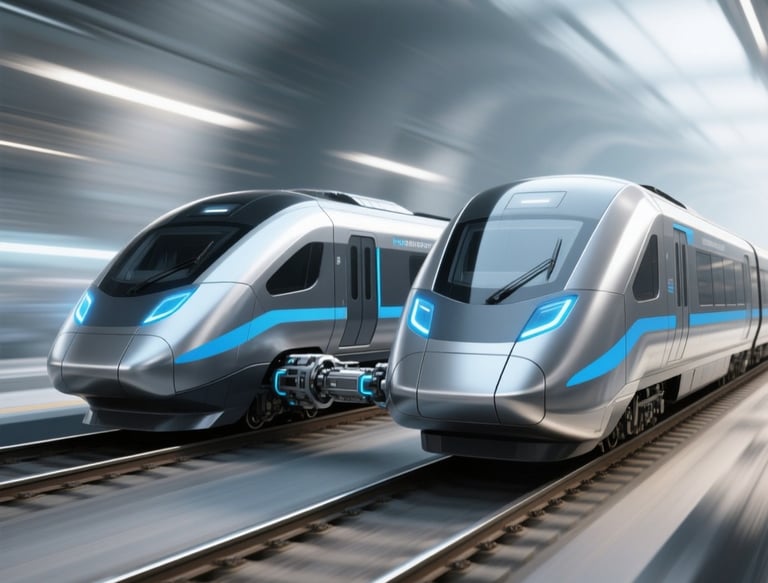
The European Commission has unveiled a sweeping new plan to fast-track high-speed rail development across the continent — a central pillar of its long-term climate-neutral mobility strategy. The initiative targets a full transformation of the Trans-European Transport Network (TEN-T), which connects over 430 major cities and regions across all member states. Under the new framework, the Commission intends to double the length of the EU’s high-speed rail corridors by 2040, linking capitals and key metropolitan areas through continuous, interoperable lines. Core projects include the completion of cross-border routes such as the Lyon–Turin rail tunnel between France and Italy, the Brenner Base Tunnel linking Austria and Italy, and the Rail Baltica corridor that will connect Finland, Estonia, Latvia, Lithuania, and Poland through a unified standard-gauge line. Together, these projects will reshape passenger and freight mobility across Europe, offering travel times under four hours between most major cities and providing a carbon-efficient alternative to short-haul flights and highway freight transport.
The Commission’s plan focuses not only on constructing new infrastructure but also on modernizing and harmonizing existing networks. One of the key challenges has been the lack of interoperability — differing national standards in signaling, electrification, and track gauges that hinder smooth cross-border operations. To address this, the EU will expand the deployment of the European Rail Traffic Management System (ERTMS) across all member states by 2030, ensuring seamless communication and automatic train control throughout the network. The policy also emphasizes high-speed electrified lines capable of operating at 250 km/h or more, along with digital ticketing systems to integrate international rail travel into a single European platform. Funding mechanisms will include a mix of the Connecting Europe Facility (CEF), the European Investment Bank (EIB), and national co-financing. The Commission expects that the revised TEN-T core network will receive around €600 billion in cumulative investment by 2050, supporting not only new lines but also station upgrades, maintenance hubs, and green energy integration along the corridors.
Major construction work is already underway in several priority zones. In Central Europe, the new high-speed line between Dresden and Prague will cut journey times by more than half, forming a critical segment of the North Sea–Baltic corridor. In Southern Europe, Spain and Portugal are finalizing plans for the Lisbon–Madrid connection, designed to bring both capitals within three hours by rail. Germany’s network upgrades will integrate with French TGV and Dutch Intercity systems, allowing seamless travel from Paris to Berlin in under six hours. Meanwhile, in Northern Europe, the Rail Baltica project — stretching nearly 870 km — has entered its next construction phase with EU-backed funding exceeding €2 billion. The Commission envisions that by 2040, high-speed trains will link Helsinki to Milan, Warsaw to Paris, and Lisbon to Vienna, forming a truly continental grid of sustainable connectivity. This ambitious network is not only expected to reduce Europe’s transport emissions by up to 30% but also to create hundreds of thousands of jobs in construction, engineering, and rail technology. Through these coordinated investments, the EU aims to position rail as the backbone of a modern, integrated, and green European transport system for decades to come.